10 Common Mistakes Overseas Buyers Make When Sourcing from Chinese Factories
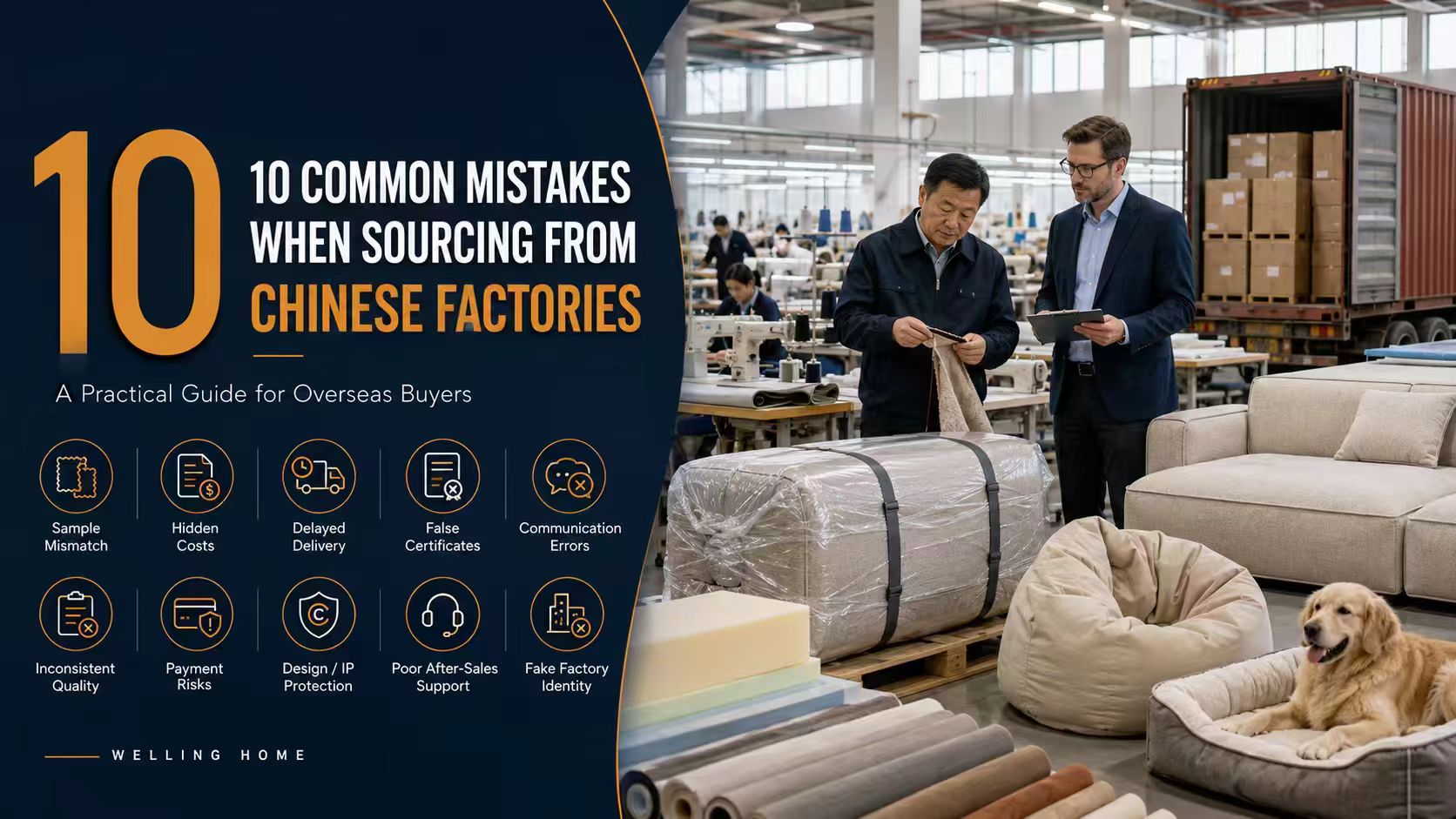
China remains one of the world’s most important manufacturing centres. From furniture and homeware to electronics, textiles and pet products, overseas buyers can find experienced manufacturers, complete supply chains and highly competitive production capabilities.
However, sourcing from Chinese factories is not simply about finding the lowest quotation.
The real challenge is finding a manufacturer that can consistently deliver the agreed quality, price, lead time and service—not only for the first sample, but also for every production order that follows.
Many sourcing problems can be avoided if buyers know what to check before placing an order. Based on practical export and manufacturing experience, here are the 10 most common mistakes overseas buyers make when sourcing products from China.
1. The Sample Is Perfect, but the Bulk Order Is Downgraded
One of the most common China factory sourcing risks is the difference between the approved sample and the actual bulk production.
A supplier may use better materials, more experienced workers and stricter inspection procedures when producing the sample. Once the bulk order begins, however, the supplier may reduce material thickness, change the foam density, use cheaper fabric or replace certain components without the buyer’s approval.
Some changes are difficult to identify from appearance alone. The product may look almost identical but perform very differently in areas such as:
-
Durability
-
Load-bearing performance
-
Colourfastness
-
Fabric abrasion resistance
-
Foam recovery
-
Chemical compliance
-
Product lifespan
For furniture products, for example, changing the fabric weight, foam density, filling ratio or sewing construction can significantly affect comfort and long-term performance.
How buyers can avoid this problem
The approved sample should not be treated only as a visual reference. Buyers should document the important specifications, including material composition, dimensions, weight, colour, tolerances, filling quantity and required test standards.
A reliable Chinese manufacturer should be willing to confirm these details in writing and maintain the same material standards throughout bulk production.
2. A Low Initial Quotation Is Followed by Hidden Charges
A very low quotation can be attractive, especially when comparing multiple Chinese suppliers. However, the lowest initial price does not always represent the final purchasing cost.
After the buyer shows serious interest, additional charges may gradually appear, including:
-
Mould fees
-
Packaging charges
-
Pallet costs
-
Logo or label charges
-
Product testing fees
-
Sample modification costs
-
Export declaration charges
-
Small-order surcharges
-
Unexpected material price adjustments
In some cases, the original quotation is based on a high minimum order quantity that was not clearly explained. When the buyer places a smaller trial order, the unit price increases substantially.
How buyers can avoid this problem
Before comparing prices, ask each supplier to quote under the same commercial conditions. The quotation should clearly specify:
-
Product specifications
-
Order quantity
-
Packaging method
-
Incoterm
-
Port of shipment
-
Mould or tooling costs
-
Testing costs
-
Sample charges
-
Payment terms
-
Quotation validity
The best supplier is not necessarily the one offering the lowest price. It is the supplier offering the most transparent and controllable total cost.
3. The Promised Lead Time Is Frequently Delayed
Some suppliers promise an unrealistic delivery date simply to secure the order. After receiving the deposit, the order may enter a poorly managed production schedule.
During peak seasons, smaller customers may also be pushed back when a larger order enters the factory. The worst situation is when the supplier does not communicate the delay until the shipping date is approaching.
For overseas buyers, a production delay can cause much more than inconvenience. It may result in:
-
Out-of-stock situations
-
Missed retail promotions
-
Cancelled customer orders
-
Additional warehousing costs
-
Airfreight expenses
-
Contract penalties
-
Loss of market reputation
How buyers can avoid this problem
Ask the manufacturer to provide a realistic production schedule before confirming the order. Important milestones may include:
-
Material preparation
-
Pre-production sample approval
-
Production start
-
In-line inspection
-
Final inspection
-
Packing completion
-
Container loading
A reliable factory should provide regular production updates and report potential delays before they become serious problems.
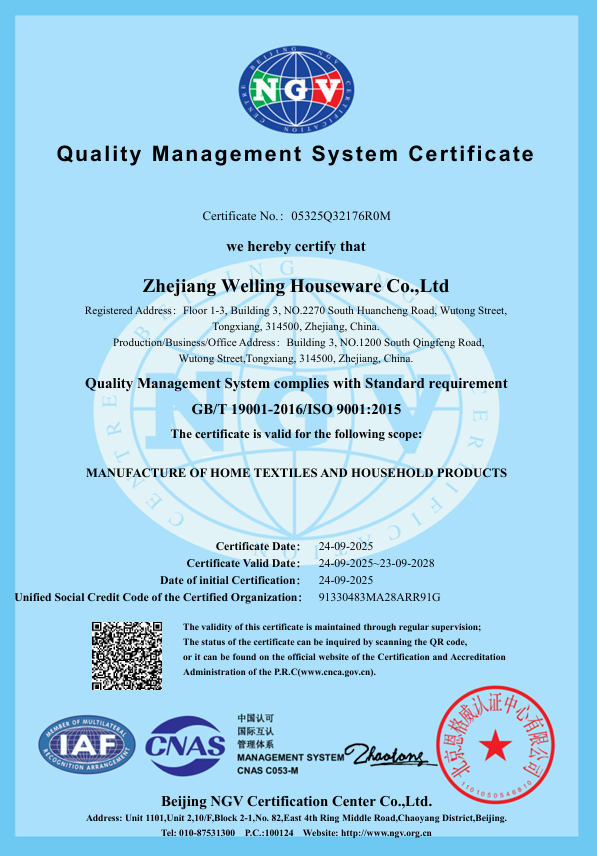
4. Certificates or Test Reports Are Forged, Expired or Misused
Certificates and test reports are essential for many international markets. Unfortunately, not every document provided by a supplier is reliable.
Common problems include:
-
Using another factory’s test report
-
Editing the company or product name on an existing report
-
Providing expired certificates
-
Testing a different material from the one used in production
-
Claiming that a component report covers the complete finished product
-
Supplying documents that do not match the required market standard
If the shipped products do not comply with local regulations, they may be rejected by the customer, detained at customs or recalled from the market.
How buyers can avoid this problem
Buyers should verify:
-
The name of the applicant
-
The name and model of the tested product
-
The testing laboratory
-
The report number
-
The issue and expiry dates
-
The tested material or component
-
The applicable market and standard
When necessary, contact the testing organisation directly or arrange independent testing using samples taken from the actual production batch.
5. Product Requirements Are Not Properly Documented
Communication problems do not always come from language differences. They often happen because important requirements are discussed through emails, messaging apps or video calls but are never included in the final order documents.
Typical missing details include:
-
Product dimensions
-
Acceptable tolerances
-
Colour standards
-
Label position
-
Logo size
-
Packaging layout
-
Barcode requirements
-
Carton markings
-
Material composition
-
Assembly instructions
-
Warning labels
The supplier may believe it has followed the order correctly, while the buyer expects a completely different result.
How buyers can avoid this problem
All critical requirements should be recorded in the purchase order, proforma invoice, specification sheet or approved technical document.
For customised products, buyers should request a pre-production sample or “golden sample” before bulk manufacturing begins.
In international sourcing, verbal confirmation is rarely enough. What matters is whether the requirement has been clearly documented and approved by both parties.
6. Product Quality Changes Between Different Orders
Some buyers receive acceptable quality on the first order but experience significant problems with the second or third shipment.
Possible reasons include:
-
Different raw-material suppliers
-
Unapproved material substitutions
-
Changes in production workers
-
Weak production procedures
-
Inconsistent inspection standards
-
Poor equipment maintenance
-
Reduced production time during busy periods
For soft furniture, batch differences may appear in fabric colour, stitching, dimensions, firmness, foam recovery or the amount of filling used.
How buyers can avoid this problem
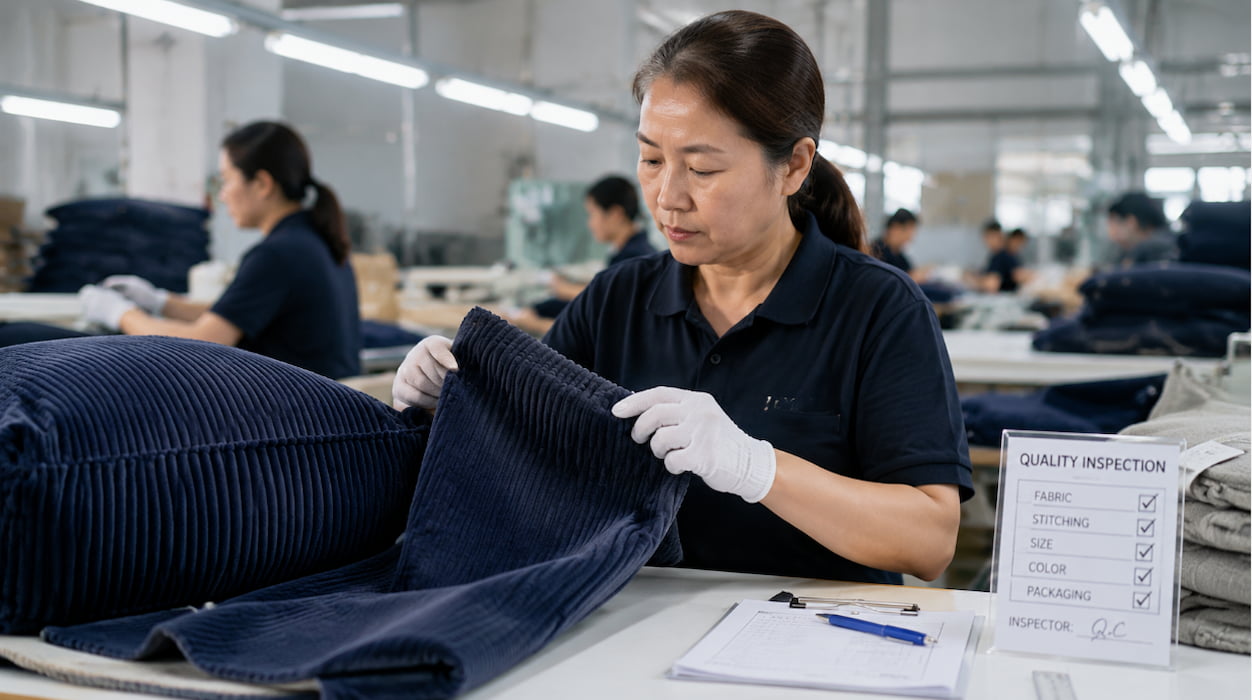
A reliable Chinese manufacturer should control both materials and production processes instead of relying only on a final inspection.
The buyer should confirm whether the factory has:
-
Incoming-material inspection
-
Approved supplier management
-
In-process quality checks
-
Standard operating procedures
-
Product identification and traceability
-
Final inspection records
-
Corrective-action procedures
Quality control is not simply about finding defective products before shipment. It is about preventing defects from being produced repeatedly.
7. The Payment Terms Place Too Much Risk on the Buyer
Some suppliers request an unusually high advance payment, such as 70% or 80% before production begins.
Once most of the payment has been made, the buyer has limited leverage if the factory delays production or delivers unacceptable quality. Recovering money across borders can be costly and difficult.
However, payment terms should also be commercially reasonable for the manufacturer. Factories normally need funds to purchase customised materials, packaging or components.
How buyers can avoid this problem
Common payment terms for established export orders include a deposit before production and the balance after inspection but before shipment.
The exact arrangement depends on:
-
Order value
-
Customisation level
-
Material investment
-
Cooperation history
-
Credit insurance
-
Inspection arrangements
-
Product type
The key is to connect payment milestones with measurable production progress. Buyers should also confirm the supplier’s registered company name and ensure that payment is made to the correct business account.
8. The Buyer’s Design or Mould Is Sold to Competitors
When developing a customised product, overseas buyers may share product drawings, packaging concepts, moulds or original designs with a manufacturer.
Without clear protection, a supplier may reproduce the design for another customer or display it publicly on a B2B platform. In more serious cases, the buyer may discover its exclusive product being offered directly to competitors.
How buyers can avoid this problem
Before sharing commercially sensitive information, buyers should use appropriate confidentiality and manufacturing agreements.
The documents should clearly define:
-
Ownership of drawings and moulds
-
Restrictions on production for third parties
-
Confidentiality obligations
-
Use of product photographs
-
Ownership after the cooperation ends
-
Remedies for unauthorised use
Buyers should also work with factories that have a strong reputation and a long-term interest in protecting customer relationships.
9. The Supplier Avoids Responsibility After Shipment
A supplier may be highly responsive before receiving the order but much less cooperative when a quality problem occurs.
Common responses include blaming:
-
The shipping company
-
Incorrect customer use
-
Local warehouse conditions
-
Installation mistakes
-
Product handling after delivery
A small discount on the next order may be offered even when the actual loss is much higher.
How buyers can avoid this problem
The order agreement should define how quality claims will be handled, including:
-
The complaint period
-
Required evidence
-
Responsibility for replacement products
-
Responsibility for rework
-
Credit-note arrangements
-
Treatment of freight costs
-
Corrective-action deadlines
A professional manufacturer should investigate the root cause, explain what happened and implement preventive action—not simply argue over responsibility.
10. A Trading Company Pretends to Be the Actual Factory
Trading companies are not automatically a bad choice. A professional trading company can offer valuable sourcing, product development and supply-chain management services.
The real problem occurs when a trading company claims to own a factory that it does not operate.
Because production is subcontracted, the buyer may have limited visibility over:
-
Raw materials
-
Production capacity
-
Quality-control procedures
-
Delivery schedules
-
Social compliance
-
Actual manufacturing costs
When something goes wrong, the intermediary may blame the factory, while the factory claims that it only followed the intermediary’s instructions.
How buyers can verify a real manufacturer
Before placing a significant order, buyers can:
-
Check the company’s business licence
-
Compare the registered address with the factory location
-
Request a live video factory tour
-
Review production equipment
-
Meet the production and quality teams
-
Arrange an independent factory audit
-
Inspect raw-material and finished-goods areas
-
Ask detailed questions about production capacity
-
Visit the factory when possible
A real manufacturer should be able to explain how the product is made, where the main risks occur and how quality is controlled.
How to Choose a Reliable Chinese Manufacturer
Avoiding sourcing problems is not about distrusting every supplier. China has many highly professional factories with strong engineering, quality-control and export capabilities.
The goal is to evaluate a supplier using evidence rather than promises.
Before confirming a new Chinese manufacturer, buyers should examine five areas:
1. Manufacturing Capability
Confirm whether the supplier has the equipment, workers, technical knowledge and production capacity required for your product.
2. Quality-Control System
Ask how the factory controls incoming materials, production processes and finished products. Quality procedures should be visible on the factory floor, not only in audit documents.
3. Export Experience
A manufacturer experienced in your target market will better understand local testing, packaging, labelling and compliance requirements.
4. Communication and Documentation
A good supplier confirms specifications clearly, reports problems early and keeps important decisions in written records.
5. Long-Term Consistency
The real test of a manufacturer is not one perfect sample. It is the ability to repeat the same quality across hundreds or thousands of products and across multiple orders.
Why Factory Transparency Matters in Furniture Sourcing
Furniture sourcing presents several special challenges. Differences in foam, fabric, filling, stitching and internal construction may not be immediately visible, but they can strongly affect comfort, durability and customer satisfaction.
For vacuum-compressed furniture, the factory must also control compression time, packing dimensions and product recovery after opening. Excessive compression or unsuitable materials can affect the final shape and performance.
This is why furniture buyers should evaluate more than the product’s appearance. They should understand how the factory manages:
-
Fabric and foam specifications
-
Cutting accuracy
-
Sewing quality
-
Filling quantity
-
Internal construction
-
Vacuum compression
-
Packaging
-
Recovery testing
-
Batch traceability
-
Final inspection
A reliable furniture manufacturer should be able to show these processes clearly.
Welling Home’s Approach to Reliable Manufacturing
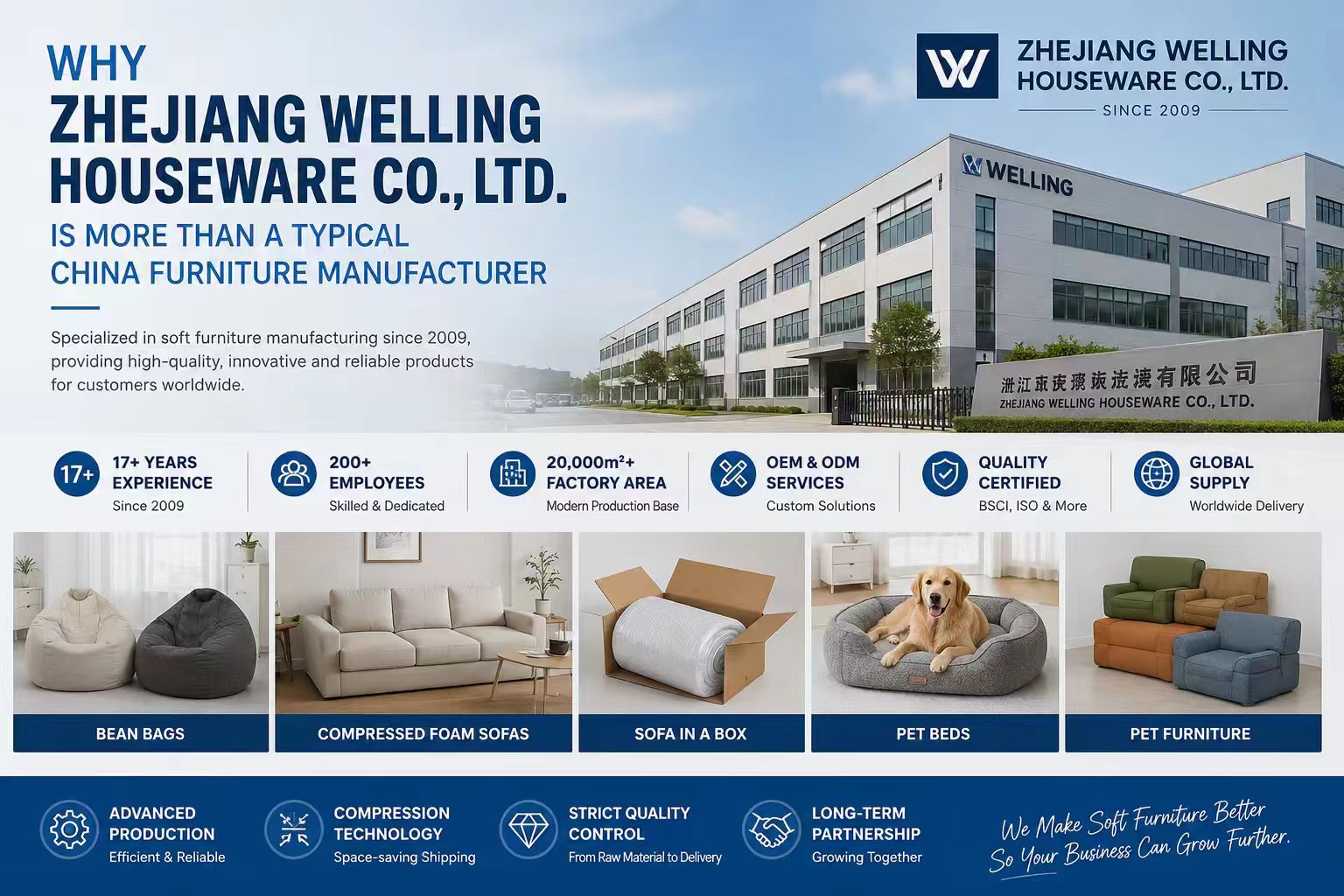
Welling Home is a soft furniture manufacturer in China specialising in:
-
Sofa in a Box
-
Vacuum-compressed foam sofas
-
Foam-filled bean bags
-
Indoor and outdoor bean bags
-
Pet beds
-
Custom soft furniture products
Since 2009, we have worked with international retailers, importers and e-commerce brands, providing OEM and ODM manufacturing services.
Our approach is straightforward: the approved product specification must be translated into repeatable production standards.
From material inspection and cutting to sewing, filling, compression and final packing, important production details are checked and recorded. For compressed products, we also evaluate packaging efficiency and product recovery after opening.
We believe a successful supplier relationship depends on four things:
Transparent specifications, stable quality, realistic lead times and responsible communication.
The lowest quotation may win a buyer’s attention, but consistent execution is what creates long-term cooperation.
Final Thoughts
Sourcing from Chinese factories can deliver significant advantages in cost, product development, production capacity and supply-chain efficiency.
However, successful sourcing requires more than comparing quotations and checking samples.
Buyers should verify the manufacturer’s identity, document every important requirement, inspect actual production, confirm compliance reports and establish clear quality and payment terms before shipment.
A reliable Chinese manufacturer should not be afraid of detailed questions. On the contrary, professional factories understand that transparency protects both the buyer and the supplier.
If you are looking for a reliable soft furniture manufacturer in China for bean bags, compressed sofas, sofa-in-a-box products or pet beds, Welling Home welcomes factory visits, video inspections and product-development discussions.
Contact us to discuss your product requirements or request a factory introduction.
Why Shredded Foam Human‑Pet Shared Sofas Are Gaining Popularity
Related Article